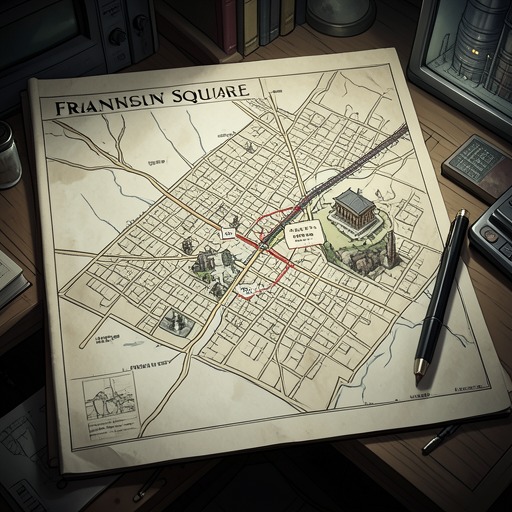
Almas Shrine Temple
The Lost SymbolAlmas Shrine Temple is a richly decorated building on Franklin Square whose role as the headquarters of the Ancient Arabic Order of Nobles of the Mystic Shrine makes it the likely referent of the pyramid’s instruction to look within the Order at Eight Franklin Square. The clue does not lead to a conventional street address: it points instead to a distinctive institution whose unexpected presence on the square changes the direction of the search.
Architecture and Institutional Identity
Turner Simkins sees the temple while watching Franklin Square: nestled between two larger buildings, it resembles an Old World mosque. Its Moorish facade is made of gleaming terra-cotta tile arranged in intricate multicolored designs. Three massive doors stand beneath two tiers of lancet windows, an imposing appearance that suggests a very different institution from the one Simkins recognizes by reputation.
The building is the headquarters of the Ancient Arabic Order of Nobles of the Mystic Shrine, an appendant body of Freemasonry more commonly known as the Shriners. Simkins associates the group with children’s hospitals, red fezzes, and parades; that familiar philanthropic image sits in striking contrast to the temple’s exotic architecture and its description as the home of a mystical order. The contrast makes the building appear both conspicuous and easy to overlook: its presence is visible, but its relevance to the cryptic message is not immediately obvious.
The Franklin Square Clue
The temple comes into focus when Inoue Sato insists that Eight Franklin Square must exist. Nola Kaye has searched for the address without success. She discovers that One Franklin Square is the name of a building, not its street address—the address is 1301 K Street—and suggests that the square’s numbering may have changed over time. Searching instead for references to an order and Franklin Square leads her to a building website, whose home page uses an image of the Great Pyramid of Egypt and describes the unusual edifice as a sacred mystical shrine designed by and for an ancient secret order.
That discovery supplies the institutional meaning of the pyramid’s clue. The search is no longer simply for a place numbered Eight Franklin Square; the crucial words point toward an Order located on Franklin Square. Almas Shrine Temple fits because it is both on the square and the headquarters of a group whose full name identifies it as an order. The solution is therefore a change in how the clue is read: the building’s identity matters more than the apparent address.
A Potential Destination Under Surveillance
Inoue Sato recognizes the danger in the discovery. She directs Turner Simkins to reposition and watch the temple’s entrance carefully, reasoning that Mal’akh may recognize the building from the pyramid and bypass the planned rendezvous to go directly there. The temple thus becomes a possible destination in an active pursuit, rather than merely the answer to an architectural riddle. Simkins’s unfamiliarity with the shrine and its order also shows how a conspicuous landmark can remain outside the working knowledge of people who have long operated in Washington.
Robert Langdon independently recognizes Almas Temple, though he has forgotten that it stands on Franklin Square. When Mal’akh identifies the building while holding Langdon captive and asks him to interpret the pyramid’s base, Langdon agrees that the temple must be the place indicated by the clue. He wonders whether the temple sits above a secret staircase, but the passage presents this as a supposition, not a confirmed feature of the building. With the liquid rising around him and less than a minute to respond, Langdon is forced to treat the temple as the key to the symbols without time to test the historical fit. Its narrative importance lies in this double role: a real, recognizable institution anchors the cipher, while the question of what secret lies within it remains urgent and unresolved.